Suspended Between Worlds
Part 1. Low-dose testosterone and a science fiction approach

This is going to be the start of a short series based on a talk I gave in June of 2023 to a small audience in the basement of a “mythical, magical” gift shop in my hometown in Washington. I talked about my process for deciding to start low-dose testosterone, and how I conceptualized it as an experimental, science-fiction type of experience. I have since stopped taking testosterone, but I view that time in my life—a period of almost four years—as a fantastic and precious experiment, one in which I was able to push the bounds of my lived experience and develop the ways I thought about gender—my own, and as a living, malleable social idea. I am changed for it, physically, yes—but mostly internally, and I think for the better.
In February of 2021, after much deliberation, I made an appointment to talk to a therapist about physically transitioning—that is, starting a low dose of testosterone. I was very panicked about the whole thing, because it’s a big step—even though once you start, especially if you’re on a very low dose, the changes that happen are extremely gradual. It’s more of a mentally big step, an acknowledgement that you are going somewhere you have never gone before.
Moreover, because I am weird about gender, my relationship to physically transitioning has been pretty strange. I have no end goal in mind; I don’t really know what it is I want out of this or where I want to go with it. When a friend asked me what part of transitioning I was most excited about, I could only tell her that I was searching for a certain kind of feeling.
So I spoke to people I knew about it, I started collecting information. If you have ever researched gender transition you may know that there is a growing but not overwhelming amount of information out there; a lot of resources repeat the same rote pieces of advice and lists of effects. There is a considerable but again, not overwhelming amount of research and studies on trans men, but there is almost no available information about taking lower doses of hormones with the aim of achieving some less binary goal. So after exhausting what I could find of published research, I turned to other places: the blogs and youtube channels of trans men, and of other trans and genderqueer people who were documenting and sharing the changes in their bodies, their minds, and their feelings about both. I called up the trans people who had gone on hormones that I knew, as well as the ones who hadn’t. And that was where the wealth of information came from—just by finding other people talking about their own experiences.
Which brings me to the illuminating conversation I had with a nonbinary therapist. I sought this person out for a limited timeline of a few sessions for the main purpose of discussing gender transition. There are two main concepts I took away from these conversations. The first came about because I was going through the process of trying to justify, not only to myself but also to the world at large, why I was doing what I was doing. Because the truth is I didn’t feel like I needed to do it. I don’t have unbearable gender dysphoria. My friends and loved ones are respectful and accepting of my identity. Moreover, if any body can be a nonbinary or trans body, why did I want to change mine? It felt almost…frivolous, to be considering this, when the need to do it was not overwhelming. I felt like I was only doing it because I wanted to, because I was curious about what would happen, and that didn’t feel like enough to justify it.
The therapist was the one who first introduced me to the term cis-sexism—a term that, more specifically than a word like transphobia, highlights the implicit hierarchies between cis and trans existence and ways of seeing the world (that were also healthily internalized within my own mind, it would appear). That is, I was looking at the whole situation through a lens bent in the direction of cis-ness, and neither cis people nor a cis perspective are going to understand why I wanted to transition. Why would they? They don’t want to transition. Using a cis perspective, I realized I would never be able to validate or even fully articulate these bodily desires. In order to understand myself, I had to come to see the world—my body included—in a way particular to me. And that is not only a trans or nonbinary perspective, but also a perspective that’s very unique, and one that I would have to build on my own, using my own experiences and thoughts and ideas and obsessions to create: my interests in stories, magic, fantasy, in the unknown, in ghost stories, in the uncanny, in science fiction.
And so this is what I started to do as I began low-dose testosterone. I began the work of building my own mental models and systems of thought to understand, at least in part, what I was doing, what I wanted to do, and why I wanted to do it. To queer and trans my gaze, so to speak, of the world at large and my own self and body; to see myself from a perspective that was all my own.
The other idea the therapist introduced me to came about when I began talking about the so-called “irreversible effects” of transitioning. This is something that the medical literature and doctors love to explain, over and over, before you go on hormones: there are things that will change when you go on hormones, but will revert back to their original state if you stop. For example, body fat redistribution. However, there are also irreversible effects that you won’t “get back” if you go off the hormones, like hair growth for example—if you’re on the big T for a while and then you stop, you may always have to shave your face. Another one is male-pattern baldness. Once that hair is gone, you won’t grow it back if you stop taking testosterone.
So to some extent this is useful information. But I can tell you from personal experience in medical settings and from reading the accounts of other trans people that it is over-focused on to the extent that it tends to devalue the patient’s own reasons for transitioning, presupposing a cis perspective: obviously a cis person wouldn’t want these changes to happen, so they are most concerned about being able to backtrack. This narrative seems to think the trans person will magically realize they are not trans, and want to reverse the process1. And sure, maybe this does happen sometimes.2 Yes, there are risks involved from a medical point of view (though to my mind these are somewhat overblown, because if you really regret it, it is usually not very difficult physically to go back to living in your assigned gender at birth—not to get ahead of myself). Moreover the situation is fraught because many—especially trans-nonbinary people—decide to go off hormones, or off and on them again, to achieve desired effects but avoid others. Perhaps they want a lowered voice, or body hair, which help their gender expression to be more in line with what they want, such that they don’t need to continue hormone treatment. This isn’t something that, say, a medical professional who isn’t trans is going to understand all that well, at least not at first glance.
In sight of all of this I complained to the therapist that I felt like they wanted me to focus on the wrong thing—these irreversible qualities—rather than the actual meat of what I was doing: this crazy and interesting mental and physical experience of morphing my body into something different, something that might set me at ease and reflect some inner plane of existence a little better—but something where I didn’t know what the hell I was doing or how I would feel afterward or what I would look like afterward.
The therapist said, “What I like to take is the Science Fiction approach.” They said, we live in a world of technological and biological wonder. If you don’t want hair to grow in a place, get laser hair removal. If you get top surgery and then regret it, get breast implants. If you start losing your hair and you don’t like that, get hair plugs or wear a wig. We as trans people already know that the body is malleable, and there are and have already been so many leaps and blocks to overcome to get to the point where we could change our bodies via hormones and surgery3; why do we need to accept this insistence on “irreversible changes?” Take a science fiction approach. What doesn’t seem possible might not actually be so impossible. We as trans people see the world in a different way, are even able to move through and inhabit multiple worlds, and spaces between worlds, and perhaps we can enjoy this, and use it to our advantage.
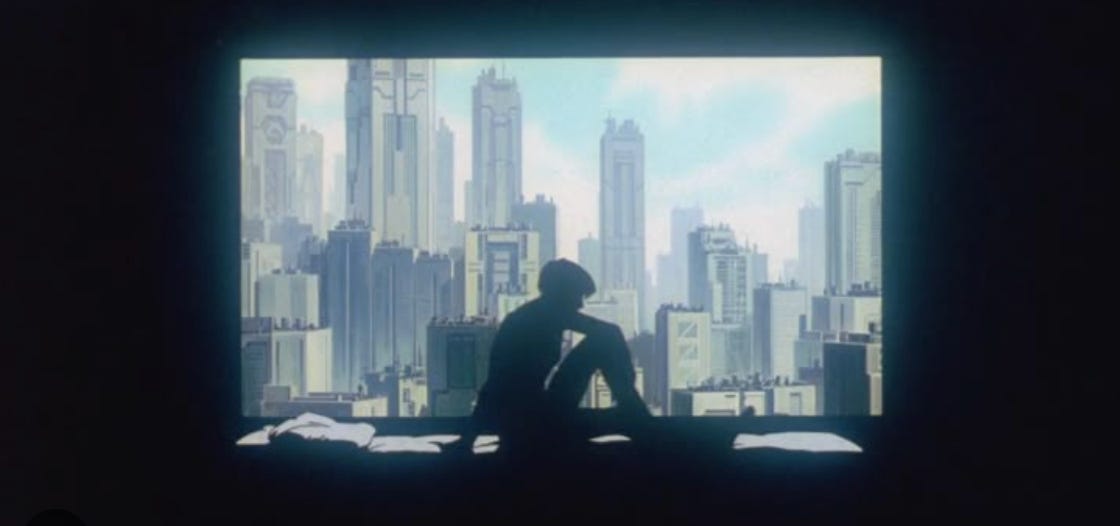
This is the first in a short series based on the talk; in the next sections I’ll talk about two science fiction works using a trans/queer reading, and I’ll discuss how the worlds we inhabit contain multitudinous possibilities and spaces between them—when we break them, when we reach our borders and boundaries, when we experience the porousness of our own limiting definitions. The first work is Ghost in the Shell, the 1995 anime film directed by Mamoru Oshii; the second is Blade Runner, the 1982 film directed by Ridley Scott.4
Another part of this may be something in vein of a transformative epistemic experience, as Celine Nguyen describes in this awesome essay. Similar to the way a straight-identifying person may be fearful of experimenting with same-sex intimacy, a cis person may be fearful of experimenting with gender, not because they might not be able reverse the physical changes but because they might learn something about themselves they weren’t sure they wanted to know. You’ve given yourself an experience from which you can never go back; you are changed, and that is the real irrevocability. You can never truly become who you were before you had the experience, because experience exists on the arrow time, and you can’t go backwards.
Though in the many reasons one can probably come up with to detransition, there are so many more that are about the circumstances—family pressure, harassment and discrimination, losing a job, lack of access to insurance, transitioning being too hard—as opposed to being about the internal gender state of the individual.
Not to mention all this stuff is also done by cis people! A lot!
Both of these stories have some obvious resonances in terms of transness. They both feature androids, bodies that have been manufactured, usually by some large private corporation which has ties to the state; in both, these characters contemplate what that means for who and what they are, and what makes them human, if they do indeed even identify as human. I want to point out here that both of these stories explicitly treat these people as minorities, or as people who have particular life experiences that the general populace doesn’t have and doesn’t understand. There are a lot of science fiction stories that concern whole races that have a different sexual or gender system, be that cultural or physical—The Left Hand of Darkness by Ursula K. Le Guin is the one that most readily comes to mind for me, which is a wonderful book—but I generally find while those stories are really interesting, it is not their purpose to tackle the alienating feeling of being trans in a primarily cis society, which is partly why these are the pieces I’ve chosen.